How Flu Spreads in the Workplace and What Can Be Done
Flu can flourish in a workplace environment because of how the virus is spread. Flu is commonly spread from respiratory droplets that can travel up to three feet from the cougher or sneezer. Breathing in these droplets or touching something with the virus on it, like a phone or doorknob, and then touching the eyes, mouth, or nose can infect a person. The more employees there are in a work area, the more chance there is of coming in contact with the virus through the air or shared surfaces.

For these reasons, it’s important to limit exposure to others while contagious. Adults can infect others with flu up to one day before symptoms show and up to seven days after getting sick. However, all too often employees return to work while still infectious.
Absenteeism vs. Presenteeism
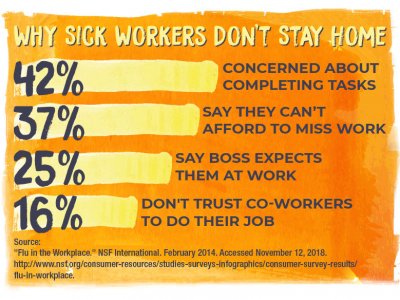
People are compelled to go to work for several reasons, according to a national survey. Among them: concern about work not getting done (42 percent); no paid sick days (37 percent); expectation from boss to be present (25 percent); and distrust toward co-workers to do the job while they are out (16 percent). (Source: February 2014 survey from NSF International.)
Although absenteeism may be a better choice, many choose presenteeism — coming to work while not able to function at a normal level. This may lower productivity, extend their illness, and infect co-workers.
What Businesses Can Do

Fortunately, there are several options for businesses to cut down on the spread of flu during the peak of the season.
- Stress the importance of staying home while contagious.
- Invest in IT solutions that allow employees to work from home, if possible, as they feel better but are still contagious.
- Ask janitorial services to give extra attention to wiping down high-traffic surfaces like copiers or the break room microwave.
- Provide disinfecting towels for employees to be proactive.
- Stock the area where employees find over-the-counter aids with Oscillococcinum® to keep productivity high. Oscillo® reduces the duration and severity of flu-like symptoms as evidenced by four clinical studies. The key is to have it on hand. In one study, researchers found that 63 percent of patients who took Oscillo within 24 hours of the onset of symptoms showed “complete resolution” or “clear improvement” within 48 hours.1
What Employees Can Do
Employees should do their part by calling in sick or avoiding close contact with co-workers when contagious. Practice good “flu etiquette” by covering the nose and mouth when coughing or sneezing. Wash hands frequently and try not to touch mucous membrane areas like the eyes, mouth, or nose that are susceptible to germs. And keep Oscillococcinum handy in a desk drawer to take at the first sign of symptoms.
Why Employers and Employees Should Care About Flu
Every year, between 5 percent and 20 percent of the U.S. population get flu. Estimates of the effect from the common flu strain on productivity vary because of monitoring difficulties. Yet, most statistics demonstrate that businesses should consider the impact.
The Center for Health Research Rural Advocacy at Geisinger Health System in Danville, Pa., “calculated the total cost of presenteeism in the United States to be more than $150 billion per year.” Sick workers are less productive, take longer to get better and often infect their colleagues. (Source: Paul Hemp, Harvard Business Review, October 2004.)
“About 10 percent to 12 percent of all absences from work are because of the flu. That translates to about 15 million lost workdays a year. And that doesn’t count people who come to work sick and perform under par, or healthy workers who stay home to take care of sick relatives.” (Source: Roslyn Stone, COO of Corporate Wellness, Inc., a health service company based in New York City. Tallahassee Democrat, Nov. 17, 2005.)
In a typical year, it is estimated that flu in the workplace may result in as much as $10 billion in lost productivity. (Source: David Cutler, Harvard University health economist. “Flu vaccine shortage could cost the U.S. $20 billion,” Associated Press, October 21, 2004.)
1. Papp, R., G. Schuback, E. Beck, et. al. “Oscillococcinum® in Patients with Influenza-Like Syndromes: A Placebo-Controlled Double-Blind Evaluation.” British Homoeopathic Journal 87, no. 2 (1998): 69-76. doi:10.1038/sj.bhj.5800208.